コース進捗 コース目次 48レッスン中 48件を公開中
第0部 読み方ガイド:私たちは何を学ぶのか
第1部 世界モデル:エージェントの頭の中にある実験場
第2部 画面を状態に変える:LeWMのモデル構造
第3部 モデルの抜け道を防ぐ:予測損失とSIGReg
第4部 モデルを行動に使う:潜在空間での計画
第5部 エンジニアリング再現:論文から動くシステムへ
第6部 LeWMは何を学んだのか
第7部 「予測が正確」でも「計画がうまくいかない」のはなぜか
第8部 再現者から研究者へ
付録 数学・実装・再現・査読のための参照資料
まず大きな絵
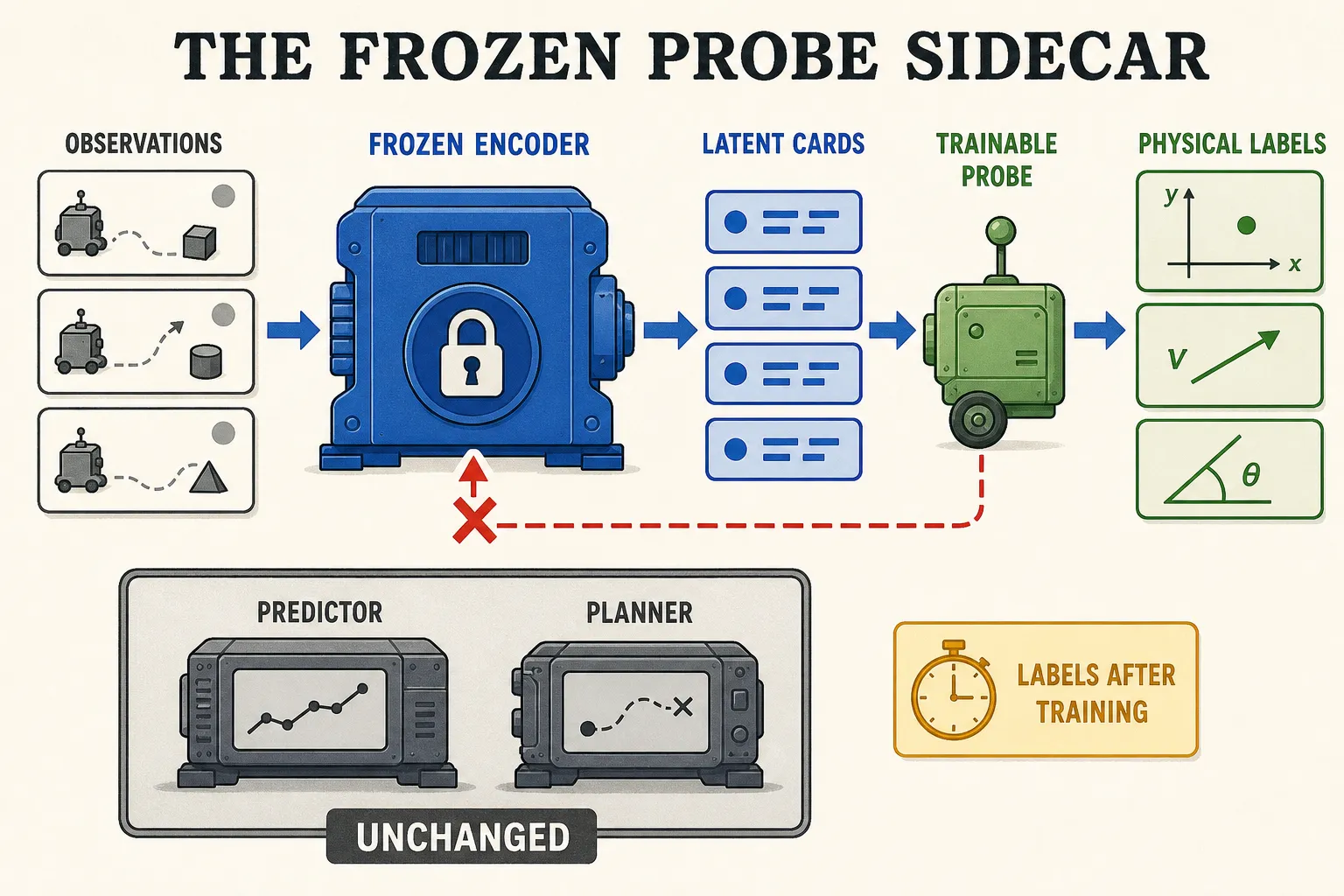
- 凍結1つの named representation を変えない。
- episode split隣 frame の leakage を防ぐ。
- readout を fitlinear ruler、次に controlled MLP。
- “recoverable” と言うuse には別の test が必要。
小さなお話
空港 scanner が suitcase の中の鍵を見つけました。これは、この見方なら scanner が鍵の情報を回収できることを示します。旅行者が鍵を知り、使うことは示しません。
probe も同じです。trained representation を凍結し、latent vector を集め、simulator label を読む小さな readout を学習します。成功が示すのは、この representation、readout、split、distribution での statistical accessibility です。predictor や planner が使う証拠ではありません。
本当のルール
attachment point を encoder output、projected state、predictor input/output のどれかまで書きます。checkpoint、eval mode、crop、resize、normalization、pooling、projector、history construction を凍結します。probe gradient が encoder を更新したら supervised fine-tuning です。
embedding extraction や target normalization より前に、complete episodes を split します。training episodes で fit、validation で hyperparameter selection、untouched test で1回評価します。random frame split で隣 frame を両側へ置くのは independent generalization ではありません。
LeWM v3 の reported targets:
- TwoRoom:2D agent position。
- PushT:agent location、block location、block angle。
- OGBench-Cube:joint position/velocity、end-effector position/yaw、gripper state、block position/quaternion/yaw。
target distance は tutorial extension で、v3 target ではありません。論文は linear/nonlinear probes の MSE と Pearson correlation を報告します。correlation は scale bias があっても高く、average MSE は悪い dimension や rare contact slice を隠せます。
linear probe は simple affine accessibility、MLP は richer hypothesis class への accessibility を試し、shortcut も使えます。両方の capacity、regularization、optimization、tuning budget を公開します。
だまされる反例
すべての TwoRoom episode がだいたい同じ時刻に door を通り、corner mark が frame index とともに明るくなるとします。random-frame split なら、MLP や linear probe は time から position を当てられます。
episode split、policy speed randomization、mark removal で performance が落ちても、元の結果は嘘ではありません。「time と position が結び付いた distribution で position が recoverable」だっただけです。
controls は constant-mean predictor、simple pixels/privileged observable、untrained encoder、shuffled labels、train-vs-test curves。TwoRoom は open floor/wall/doorway、PushT は free motion/approach/first contact/sliding/rotation に slice します。
use を試すなら、probe 後に variable-associated subspace を perturb し、同じ episodes/candidates で matched-size random directions、norm-preserving noise、no intervention と比べます。behavior change も entanglement や OOD latent の結果かもしれないため、言えるのは “behaviorally implicated under this intervention” までです。
実験のレシート
後続結果は境界を具体化します。
- Objective Bottleneck:1つの TwoRoom follow-up system で terminal latent L2 vs true endpoint distance Pearson (r=0.426)、ridge position probe held-out (R^2=0.9922)。
- SCALE:state-regression control は一部 task で full-embedding decodability を match/exceed しても distance alignment を match せず、13/15 task–solver averages を改善。SCALE は15/15。
- Decision-Metric Alignment:4 non-collapsed PushT variants の probe (R^2) 差は0.03未満。一方 Plan–Real Spearman は+0.280から約+0.410–+0.420、online success は49.3%–92.7%。各 config 1 training run、3 seeds は evaluation variation。
別々の author-reported protocols です。decodability と planner-facing geometry が分かれうることを示しますが、万能な1 mechanism は確定しません。元の v3 は全 probe を exact reconstruct できる implementation detail が不足しています。
3つのクイック質問
- original representation を probe するため、何を凍結しますか。
- MLP success は linear success より何を示し、何を示しませんか。
- recoverability から behavioral relevance へ進む intervention は何ですか。