コース進捗 コース目次 48レッスン中 48件を公開中
第0部 読み方ガイド:私たちは何を学ぶのか
第1部 世界モデル:エージェントの頭の中にある実験場
第2部 画面を状態に変える:LeWMのモデル構造
第3部 モデルの抜け道を防ぐ:予測損失とSIGReg
第4部 モデルを行動に使う:潜在空間での計画
第5部 エンジニアリング再現:論文から動くシステムへ
第6部 LeWMは何を学んだのか
第7部 「予測が正確」でも「計画がうまくいかない」のはなぜか
第8部 再現者から研究者へ
付録 数学・実装・再現・査読のための参照資料
まず大きな絵
- 正しい machine?graph と version を trace。
- 正しい evidence?probe、cause、theorem、benchmark は別。
- 正しい scope?condition、failure、reproducible path を pin。
小さなお話:八人の inspector
manuscript は流暢で、figure は美しく、table の decimal も整っています。それでも八人の inspector が止めます。一人は発明された teacher network、次は v3 に密輸された後続 preprint、残りは probe が何を証明するか、benchmark condition はどこか、“caused” は妥当か、theorem assumption は何か、failed seed はどこか、code link がなぜ moving main なのかを尋ねます。
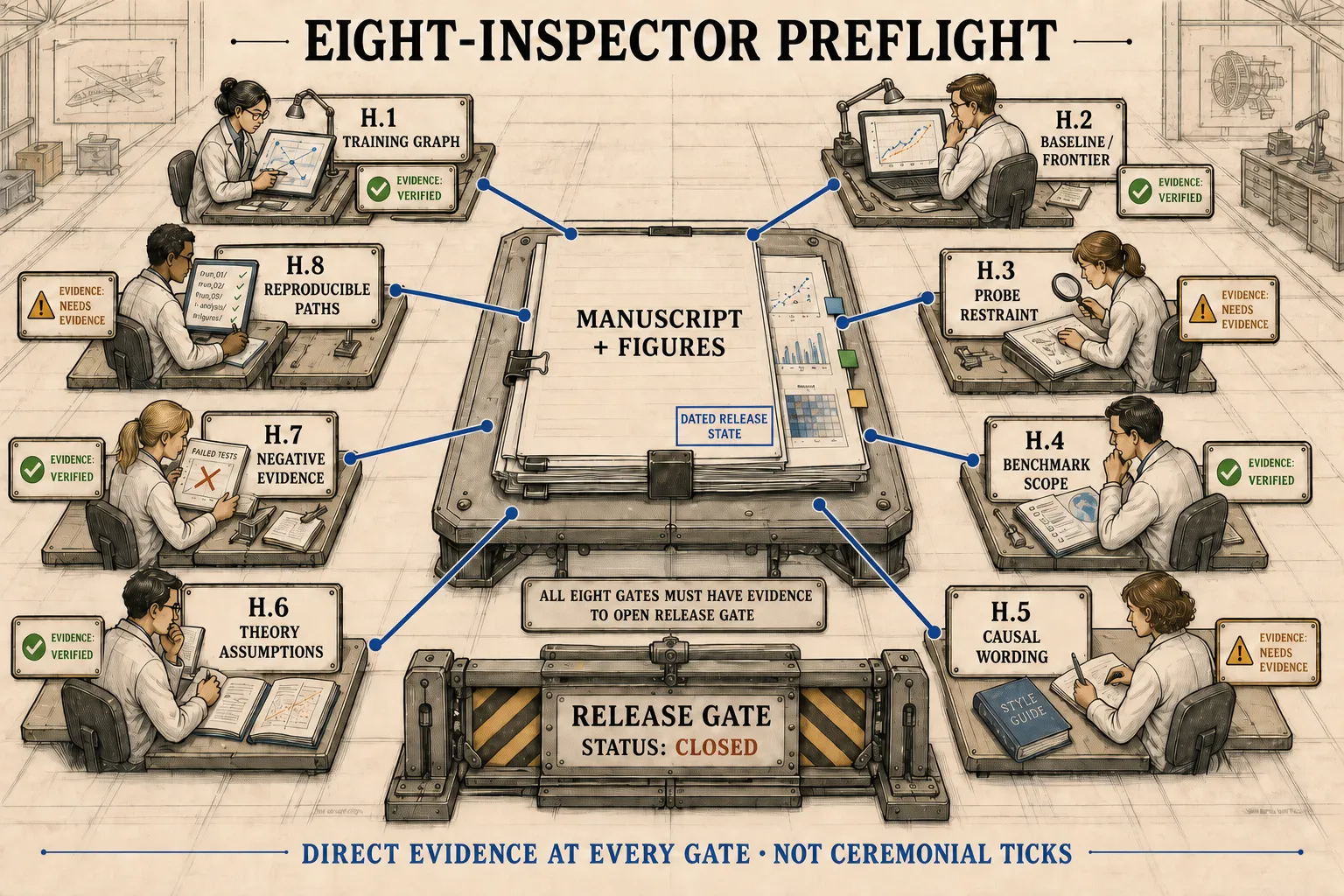
check mark は evidence ではありません。各 pass は primary source、frozen implementation、controlled experiment、explicit assumption、raw result、declared tutorial construction のどれかを指します。
review 前に “LeWM works” を、subject、mechanism、model version、environment、data、planner/budget、evidence type、conclusion strength を持つ checkable sentence に書き換えます。
八つの gate checklist
H.1 Original training graph は正確か?
- 一つの shared trainable visual encoder が context と shifted next observation を処理。
- shifted target は同じ model が encode し detach しない。prediction gradient は connected encoder route の両方へ届く。
- action は transition と align して predictor を condition。SIGReg は observation-embedding population を regularize。
- Original v3 に stop-gradient target、EMA teacher、pretrained visual encoder はない。
- goal image、CEM、reward、probe、optional decoder は baseline training lane の外。
この gate の pass が証明するのは graph identity と可能な gradient route であり、non-collapse、physics、rollout accuracy、planning success ではありません。
H.2 Baseline と後続 route は分離されているか?
- 全 later method に passport を付ける。title、exact version/date、changed layer、targeted failure、evidence level、code status、independent-reproduction status。
- LeJEPA は引用した motivation/theory にだけ使い、後続 detach、auxiliary head、cost、hierarchy、teacher を v3 に import しない。
- “defines/proposes”“authors report”“theorem under assumptions”“independently reproduced”“tutorial construction” を区別。
- recency、acceptance、public author code を別 fact とし、evidence ladder にしない。
H.3 Probe と picture を控えめに解釈しているか?
- probe family/capacity、train/test split、preprocessing fit、episode leakage control、shuffled label、simple/raw-feature baseline を記録。
- “この protocol で linearly decodable” と言い、“model が variable を learned/uses/understands” と言い換えない。
- t-SNE/UMAP、reconstructed image、latent trajectory、VoE surprise を conditional view とし、semantics/intuitive physics の証明にしない。
- use/cause を主張するなら intervention を足し、その side effect を開示。
H.4 Benchmark claim は condition 内にあるか?
- environment/task、data、model、planner、action/search/compute budget、pretraining、seed policy、episode ledger、metric、hardware timing を付ける。
- speed multiplier の denominator を検査。model call、batching、rendering、candidate、horizon、GPU、pretraining accounting。
- scope を分離。TwoRoom topology、PushT 2-D contact、simulated Reacher、simulated OGBench-Cube だけでは general robotics、physical understanding、safety を確立しない。
- author-reported weakness と possible explanation は “possible” のまま。mean だけでなく goal/failure distribution を調べる。
H.5 Language は correlation と causation を分けるか?
- “velocity と correlate、したがって uses velocity” や “SIGReg が success を変えた、したがって Gaussianity が physics を caused” の jump を丸で囲む。
- 最も近い alternative を challenge。physical state を固定して appearance を変える。dynamics 固定で cost を swap。cost 固定で dynamics を swap。oracle cell で bottleneck を局所化。
- ablation は capacity、optimization、support、search query を一緒に変えうる。causal wording を実際に isolate した intervention に合わせる。
H.6 Theorem assumption は conclusion に付いているか?
- 必要に応じ stationarity、transition/noise family、observation adequacy/invertibility、Gaussian/exact constraint、matched dimension、predictor expressivity、population/global optimum、signal separation、state-conditioned action excitation を明記。
- conclusion を狭く保つ。orthogonal recovery は human-named axis を作らず、controlled theory は conditional mean を identify し全 multimodal future ではない。
- benchmark gap を別々に列挙。nonlinearity、partial observability、missing action support、drift、multimodality、finite data、approximate optimization、misspecification。
- assumption が unknown/false なら “diagnostic lens, not direct coverage” と言う。
H.7 Positive、negative、null、missing result は見えるか?
- 全 declared seed または preregistered exclusion rule、uncertainty、per-episode outcome、divergence/collapse/timeout、unsuccessful ablation、stated policy で選んだ representative failure を示す。
- 未 test は open、測定して非分離は null under this setup、criterion 未達は failed under this setup。
- negative result を task、method、support、budget、protocol より広く generalize せず、物語を弱めるからと隠さない。
H.8 全 implementation claim に reproducible path があるか?
- frozen first-party file/SHA、pinned artifact + hash/format、または clearly labeled tutorial construction + divergence のどれかで終わる。
- dependency を別 pin、composed configuration、data/checkpoint conversion、episode ledger、analysis revision を保存。SHA があるのに moving
mainを使わない。 - archive smoke test。checkpoint 一つを load、window 一つを episode へ trace、summary 一つを regenerate。これは handoff test で independent reproduction ではない。
- history を保存。current v3 TwoRoom は
25/50、reproduction が audit した paper-side100/150は v1/v2。
Evidence は staircase ではなく coordinate
Decodability、predictability、controllability、generalization、causal identification、planning utility は別の質問です。decoded position を predictor が無視でき、recorded-action accuracy と counterfactual failure は共存でき、planner は identifiable state なしに task shortcut を exploit できます。
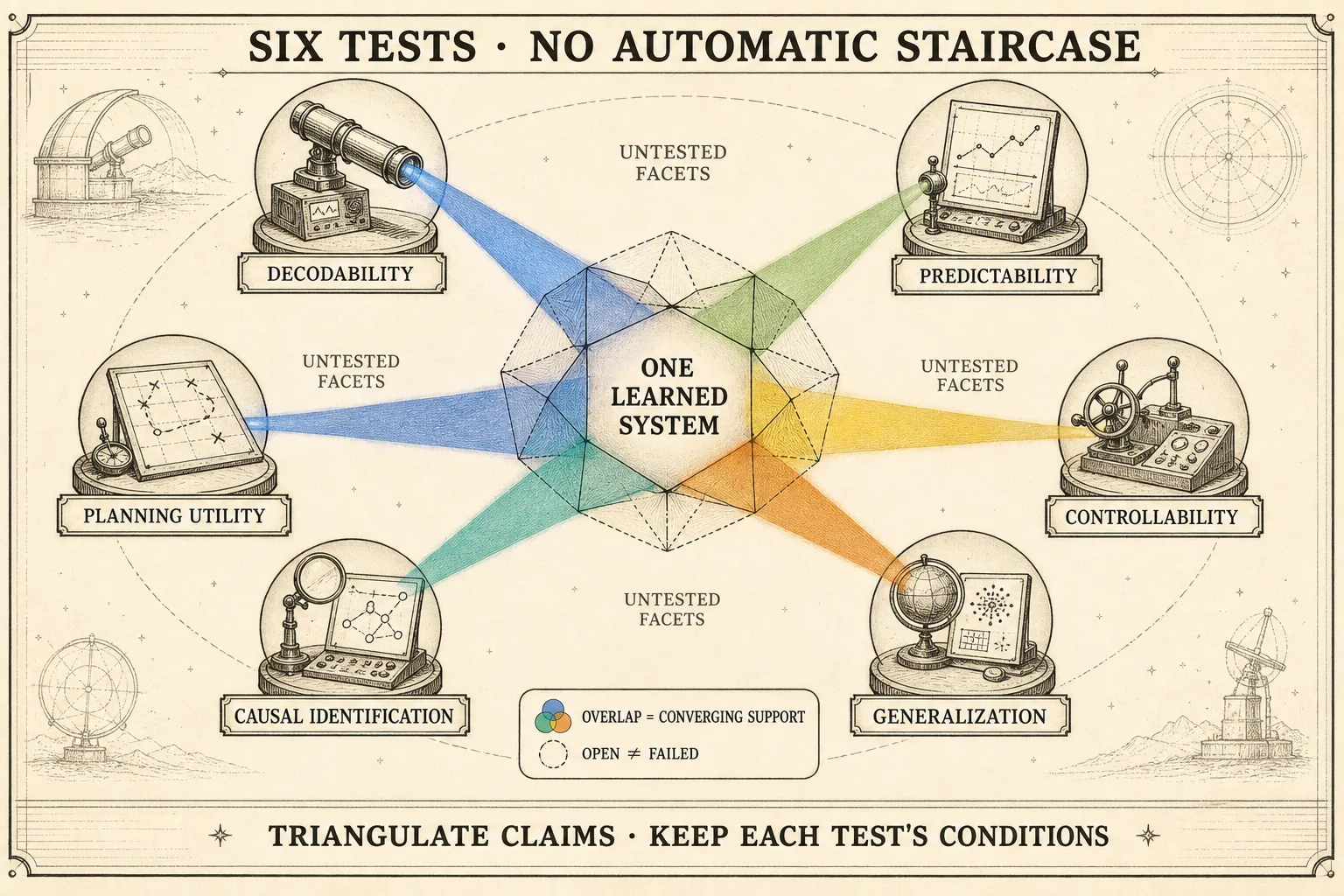
どの coordinate を test し、何が open かを尋ねます。複数 indirect signal を “understanding” 一語に混ぜません。
claim を壊してみる
“LeWM stabilizes its pretrained visual teacher with EMA and stop-gradient, then proves through probes that its Gaussian state understands physics and makes CEM universally faster.”
この流暢な sentence は全 gate に失敗します。graph は誤り、later mechanism を import、probe を understanding に昇格、speed から hardware/budget condition を除去、correlation を causality に変更、theorem assumption なし、failure 消失、frozen path なしです。
red-flag phrase は自動 rejection でなく question を起動します。proves understanding、guarantees physics、universally faster、distance is reachability、the ablation shows the cause。strong wording が残れるのは operational definition、alternative、budget、assumption、direct evidence も一緒に残るときだけです。
証拠レシート
baseline identity は LeWorldModel v3、frozen official code、cited motivation の LeJEPA v3 に基づきます。theory は passive identifiability v1 と controlled identifiability v2。independent evidence は TwoRoom reproduction v1 と documented protocol に限定します。LeWM v3 は 2026-06-03 改訂、frozen code は 2026-05-22、この checklist cutoff は 2026-08-20。全 gate pass が意味するのは dated claim が正しく attributed/scoped/calibrated/balanced/inspectable ということです。model が永遠に正しい、specialist peer review が不要、ではありません。
3つのクイック質問
- v3 図に発明された EMA teacher があると暴く direct fact は何ですか?
- strong probe が planner の variable use を確立しないのはなぜですか?
- 全八 gate を通過した後の最も強い conclusion は何ですか?