Course progress Course outline 48 of 48 lessons available
Part 0 — Reading Guide: What Exactly Are We Going to Learn?
Part 1 — World Models: An Internal Sandbox for the Agent
Part 2 — Turning Images into State: The LeWM Architecture
- 06 Chapter 5 — Trajectory Data: To the Model, the World Is Not an Image Collection available now
- 07 Chapter 6 — The Visual Encoder: Issuing a “State Passport” for Every Frame available now
- 08 Chapter 7 — The Dynamics Predictor: Moving Time Forward in the Mind available now
- 09 Chapter 8 — A Complete Forward Pass: Follow One Batch from Start to Finish available now
Part 3 — Preventing the Model from Cheating: Prediction Loss and SIGReg
- 10 Chapter 9 — The Most Dangerous Shortcut: Representation Collapse available now
- 11 Chapter 10 — Prediction Loss: How the Model Learns the Next Step available now
- 12 Chapter 11 — The Intuition Behind SIGReg: Letting Representation Space “Breathe” available now
- 13 Chapter 12 — Keep the Mathematics Minimal but Sufficient available now
- 14 Chapter 13 — The Original LeWM’s End-to-End Training Mechanism available now
- 15 Chapter 14 — Train a Model That Does Not Collapse Immediately available now
Part 4 — Putting the Model into Action: Planning in Latent Space
- 16 Chapter 15 — Goal-Conditioned Planning: From “Where Am I?” to “Where Do I Want to Go?” available now
- 17 Chapter 16 — Latent Euclidean Distance: Convenient, but Not Necessarily Reliable available now
- 18 Chapter 17 — CEM: Searching for Actions Through an Elimination Tournament available now
- 19 Chapter 18 — MPC: Do Not Trust the Model for Too Long at Once available now
- 20 Chapter 19 — Long-Horizon Rollouts: How Small Errors Snowball into Major Failures available now
- 21 Chapter 20 — Implement a Minimal LeWM Planner from Scratch available now
Part 5 — Engineering Reproduction: From Paper to Running System
- 22 Chapter 21 — The Official Repository and Experimental Environment available now
- 23 Chapter 22 — First Experiment: A TwoRoom Smoke Test available now
- 24 Chapter 23 — Second Experiment: Reproducing PushT available now
- 25 Chapter 24 — How to Evaluate a World Model Fairly available now
- 26 Chapter 25 — Failure-Diagnosis Manual available now
Part 6 — What Has LeWM Actually Learned?
- 27 Chapter 26 — Linear Probes: Which Physical Variables Are Encoded in the Latent State? available now
- 28 Chapter 27 — Give Latent Space a “Health Check” available now
- 29 Chapter 28 — Violation of Expectation: Is the Model Surprised by “Impossible Events”? available now
- 30 Chapter 29 — How to Discuss “Understanding the World” Rigorously available now
Part 7 — Why “Accurate Prediction” Can Still Produce “Poor Planning”
- 31 Chapter 30 — The Gap Between the Training Objective and the Planning Objective available now
- 32 Chapter 31 — Global Non-Collapse Does Not Guarantee Preservation of Task-Relevant Dynamics available now
- 33 Chapter 32 — When Is an Isotropic Gaussian Prior Too Strong? available now
- 34 Chapter 33 — Long-Horizon Planning: Predict Farther or Plan More Intelligently? available now
- 35 Chapter 34 — From Positional Distance to Task Progress available now
- 36 Chapter 35 — Multi-Task Learning, Real Robots, and Visual Distractions available now
- 37 Chapter 36 — Theoretical Boundaries: When Can the True State Be Identified? available now
Part 8 — From Reproducer to Researcher
Appendices
- 41 Appendix A — The Minimum Necessary Mathematical Toolkit available now
- 42 Appendix B — PyTorch Implementation Quick Reference available now
- 43 Appendix C — Complete Tensor-Shape Table available now
- 44 Appendix D — Experiment Configuration Cards available now
- 45 Appendix E — Paper Timeline and Evidence Levels available now
- 46 Appendix F — Glossary available now
- 47 Appendix G — Reproduction Checklist available now
- 48 Appendix H — Expert-Review Checklist available now
The big picture
- Observepixels + actions
- Compressmake latent states
- Imaginetry action futures
- Actsearch, move, check
This course has one spine: observe → compress → imagine → search → act → diagnose. Every later box belongs somewhere on that line.
A tiny story
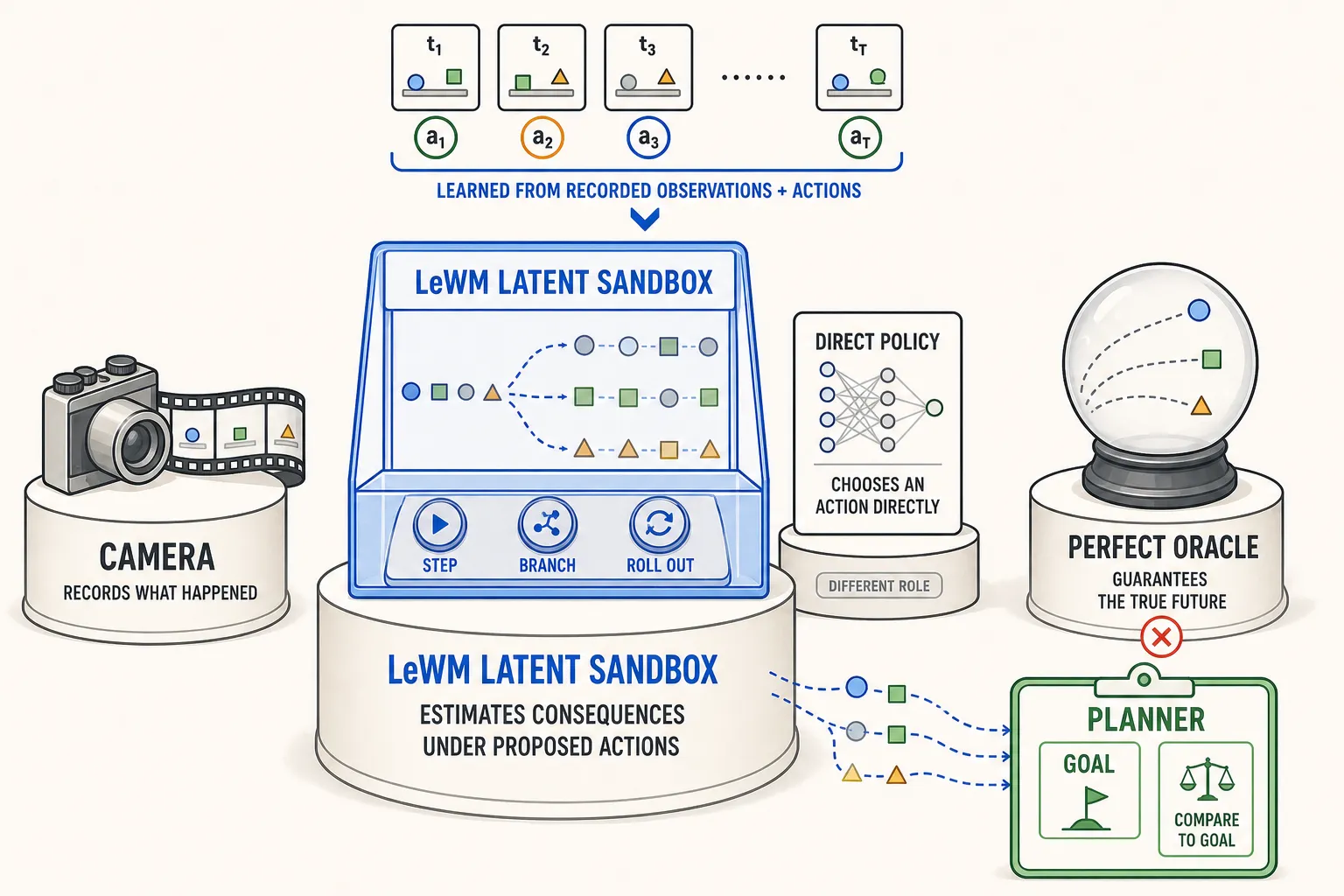
Put three tools on a robot’s workbench. A camera records one journey. A direct policy chooses an action, possibly with rich memory, without explicitly searching many futures at decision time. A world-model planner rehearses proposed actions inside a learned model before choosing.
LeWorldModel, or LeWM, is the third tool. It learns from ordered visual–action trajectories. An encoder turns an observation into a compact latent “passport.” An action-conditioned predictor advances those passports. After training, CEM searches action sequences through the frozen model, and MPC executes a configured prefix before looking again.
The passport is not a literal map. Two nearby latent points may sit on opposite sides of a real wall. A compact state can preserve wallpaper and forget the doorway.
The real rule
Keep four names separate:
- A world model is a job: represent enough change to reason about consequences.
- JEPA is a broad idea: predict a learned target representation from a context representation.
- LeJEPA studies predictive representation learning with SIGReg and non-collapse.
- LeWM adds time, actions, latent dynamics, and a planning loop.
Our baseline is LeWorldModel v3, revised 2026-06-03, plus the official code frozen at 8edfeb336732b5f3ce7b8b210d0ba370a09e2cac, dated 2026-05-22. LeJEPA v3 and the JEPA position paper v0.9.2 explain related ideas, not interchangeable implementations.
Original LeWM v3 uses one shared trainable visual encoder. Its next-observation targets stay connected to that encoder. It uses no training-time stop-gradient, no EMA teacher, and no pretrained visual encoder. Baseline world-model training needs no task reward or goal, but it absolutely needs ordered actions. The goal arrives later, during planning.
LEARN:     observations + actions -> latent dynamics + non-collapse pressure
FREEZE:    encoder and predictor
ACT:       current + goal -> CEM plans -> execute a prefix -> observe again
DIAGNOSE:  data -> representation -> dynamics -> cost -> search -> execution
The trick that fools us
Imagine a predictor that cannot hear actions. Most recorded TwoRoom trips follow the same doorway route, so history alone may predict the common continuation and produce a respectable loss. During planning, however, “up,” “right,” and “stay” all create nearly the same imagined future. CEM is holding an audition for a judge with earplugs.
That counterexample proves only this: predicting common chronology is not enough for an action-conditioned planning model. A different prediction after an action swap is necessary evidence, but it still does not prove the direction, size, or long-term effect is correct.
Evidence receipt
The course’s evidence cutoff is 2026-08-20. arXiv:2608.10145v1 independently reimplemented one single-seed TwoRoom system and reproduced a position probe and repository-protocol planning; it did not reproduce PushT, OGBench-Cube, or multi-seed robustness. arXiv:2608.12959v1 reused that system, so it is a follow-up in the same evidence chain, not a second independent replication.
TwoRoom makes walls, detours, and bad costs easy to see. PushT adds contact, rotation, and sliding. Neither benchmark proves general physics or safe real-robot control. Tutorial stories and diagrams explain mechanisms; they are not paper results.
Quick check
- Why is LeWM a rehearsal room rather than a camera or policy?
- Which original-v3 facts rule out an EMA-teacher diagram?
- Why can a reward-free world model still need a goal when it acts?