Course progress Course outline 48 of 48 lessons available
Part 0 — Reading Guide: What Exactly Are We Going to Learn?
Part 1 — World Models: An Internal Sandbox for the Agent
Part 2 — Turning Images into State: The LeWM Architecture
- 06 Chapter 5 — Trajectory Data: To the Model, the World Is Not an Image Collection available now
- 07 Chapter 6 — The Visual Encoder: Issuing a “State Passport” for Every Frame available now
- 08 Chapter 7 — The Dynamics Predictor: Moving Time Forward in the Mind available now
- 09 Chapter 8 — A Complete Forward Pass: Follow One Batch from Start to Finish available now
Part 3 — Preventing the Model from Cheating: Prediction Loss and SIGReg
- 10 Chapter 9 — The Most Dangerous Shortcut: Representation Collapse available now
- 11 Chapter 10 — Prediction Loss: How the Model Learns the Next Step available now
- 12 Chapter 11 — The Intuition Behind SIGReg: Letting Representation Space “Breathe” available now
- 13 Chapter 12 — Keep the Mathematics Minimal but Sufficient available now
- 14 Chapter 13 — The Original LeWM’s End-to-End Training Mechanism available now
- 15 Chapter 14 — Train a Model That Does Not Collapse Immediately available now
Part 4 — Putting the Model into Action: Planning in Latent Space
- 16 Chapter 15 — Goal-Conditioned Planning: From “Where Am I?” to “Where Do I Want to Go?” available now
- 17 Chapter 16 — Latent Euclidean Distance: Convenient, but Not Necessarily Reliable available now
- 18 Chapter 17 — CEM: Searching for Actions Through an Elimination Tournament available now
- 19 Chapter 18 — MPC: Do Not Trust the Model for Too Long at Once available now
- 20 Chapter 19 — Long-Horizon Rollouts: How Small Errors Snowball into Major Failures available now
- 21 Chapter 20 — Implement a Minimal LeWM Planner from Scratch available now
Part 5 — Engineering Reproduction: From Paper to Running System
- 22 Chapter 21 — The Official Repository and Experimental Environment available now
- 23 Chapter 22 — First Experiment: A TwoRoom Smoke Test available now
- 24 Chapter 23 — Second Experiment: Reproducing PushT available now
- 25 Chapter 24 — How to Evaluate a World Model Fairly available now
- 26 Chapter 25 — Failure-Diagnosis Manual available now
Part 6 — What Has LeWM Actually Learned?
- 27 Chapter 26 — Linear Probes: Which Physical Variables Are Encoded in the Latent State? available now
- 28 Chapter 27 — Give Latent Space a “Health Check” available now
- 29 Chapter 28 — Violation of Expectation: Is the Model Surprised by “Impossible Events”? available now
- 30 Chapter 29 — How to Discuss “Understanding the World” Rigorously available now
Part 7 — Why “Accurate Prediction” Can Still Produce “Poor Planning”
- 31 Chapter 30 — The Gap Between the Training Objective and the Planning Objective available now
- 32 Chapter 31 — Global Non-Collapse Does Not Guarantee Preservation of Task-Relevant Dynamics available now
- 33 Chapter 32 — When Is an Isotropic Gaussian Prior Too Strong? Current lesson
- 34 Chapter 33 — Long-Horizon Planning: Predict Farther or Plan More Intelligently? available now
- 35 Chapter 34 — From Positional Distance to Task Progress available now
- 36 Chapter 35 — Multi-Task Learning, Real Robots, and Visual Distractions available now
- 37 Chapter 36 — Theoretical Boundaries: When Can the True State Be Identified? available now
Part 8 — From Reproducer to Researcher
Appendices
- 41 Appendix A — The Minimum Necessary Mathematical Toolkit available now
- 42 Appendix B — PyTorch Implementation Quick Reference available now
- 43 Appendix C — Complete Tensor-Shape Table available now
- 44 Appendix D — Experiment Configuration Cards available now
- 45 Appendix E — Paper Timeline and Evidence Levels available now
- 46 Appendix F — Glossary available now
- 47 Appendix G — Reproduction Checklist available now
- 48 Appendix H — Expert-Review Checklist available now
The big picture
- One dotCollapse is easy.
- Spread it outSIGReg asks for Gaussian shadows.
- Check the routeA round cloud may still hide the door.
A tiny story: the round city
A mayor finds every resident squeezed into one square. The cure is a round, roomy city with no favorite direction. Crowding ends—but the real country is two islands joined by one bridge. A perfect circle is not automatically a useful travel map.
That is the tension in original LeWorldModel v3. SIGReg compares many one-dimensional projections of a batch of embeddings with a standard isotropic Gaussian. A constant representation cannot satisfy that target, so the rule is a strong anti-collapse pressure. But Gaussian and isotropic describe the population’s shape; they do not name position, velocity, a doorway, or an action-feasible route.
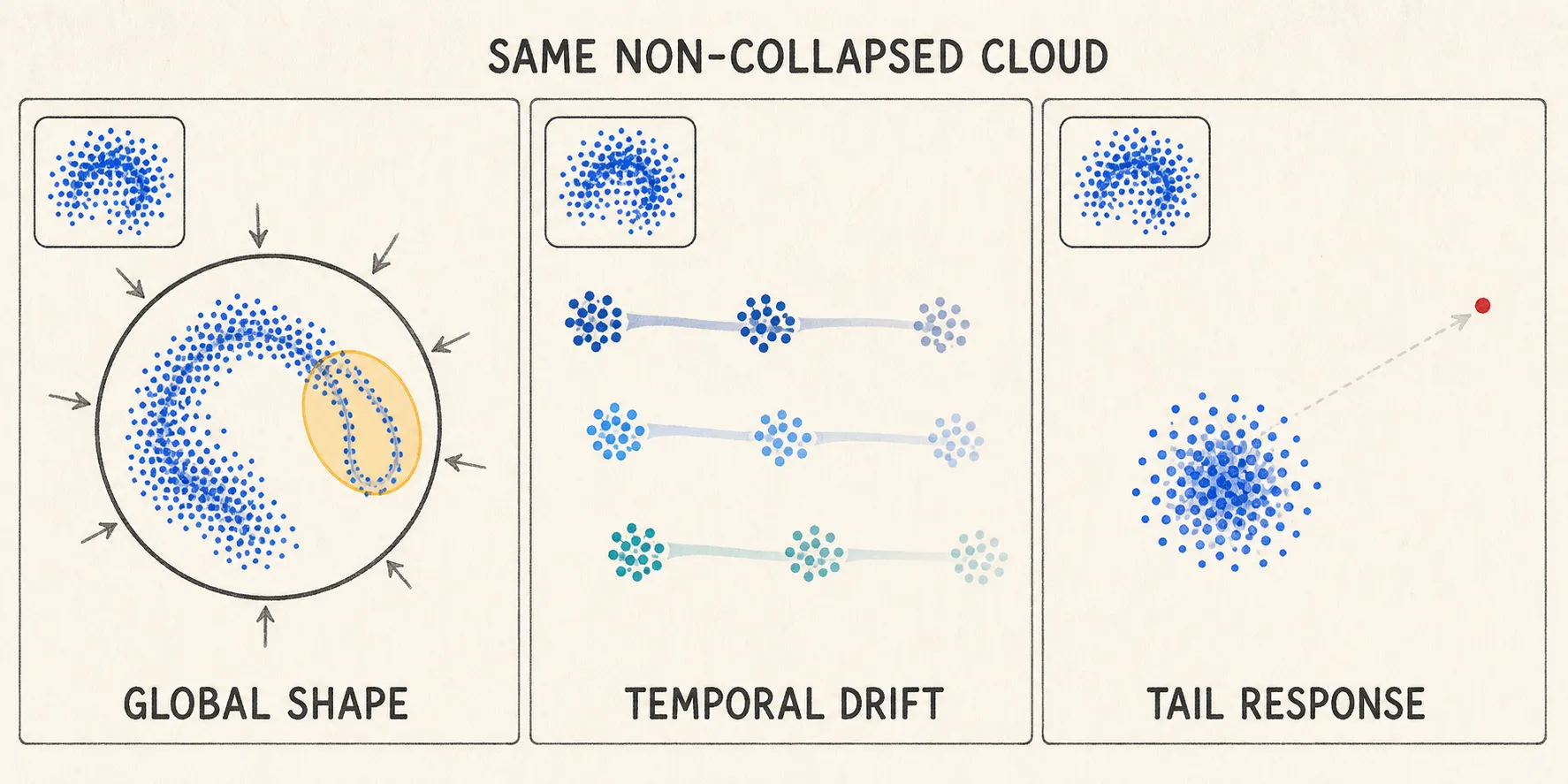
One phrase, “Gaussian mismatch,” can hide several different mechanisms. The sketches are teaching constructions, not measured embeddings or causal proof.
The technical backpack
Three checks must stay separate:
- Spread: mean, covariance, effective rank, and projected tails ask whether the population collapsed.
- Local usefulness: temporal neighbors, action branches, doorway ordering, and rollouts ask whether nearby structure helps prediction and planning.
- Decision usefulness: closed-loop success asks whether the model, terminal cost, CEM search, and execution work together.
Low intrinsic dimension is not automatically collapse. TwoRoom may vary mainly by agent location and recent motion even when its pixels are large. LeWM v3 reports weaker TwoRoom planning in its evaluated setting and suggests low diversity, low intrinsic dimension, and tension with a high-dimensional Gaussian target as possible contributors. That is an author hypothesis, not a proven cause. The independent TwoRoom audit later found that protocol details matter, and its follow-up found a terminal-metric bottleneck for its checkpoints and protocol. Neither result universally clears or condemns SIGReg.
Later papers test different repairs; none belongs to original v3:
| Later route | What it changes | What it does not prove |
|---|---|---|
| Sub-JEPA | finite frozen random orthogonal subspaces | unseen joint geometry or topology |
| TC-LeWM | SIGReg on temporally centered residuals | that slow information is useless; its evidence is LIBERO behavior cloning, not baseline MPC |
| QQWorld | sorted projection samples matched to Gaussian quantiles; an optional detached cross-batch queue | that global Gaussian shape is task-correct, or that original LeWM detaches targets |
| SMWM | inverse-action regression as anti-collapse | preservation of every task variable |
| AC-MTM | in-batch contrastive action identification | coverage for duplicate, no-op, hidden, stochastic, discrete, hybrid, or unsupported actions |
The coefficient lambda changes how loudly SIGReg speaks beside prediction loss. Tune it when the same population target seems useful but too loud or quiet. Change the structure only when controlled evidence points to a specific mismatch: full-space pressure, slow task drift, tail correction, or an unsuitable marginal target.
Try to break the idea
Build two latent maps for the same loop-shaped trajectory. Map A keeps every temporal neighbor and route in order but lives on a thin two-dimensional sheet. Map B has a beautiful spherical Gaussian population after the points are shuffled.
If Map B wins only the distribution checks while Map A wins action-conditioned rollout and planning checks, “more Gaussian” did not mean “more useful.” Now hold data, encoder, predictor, optimizer, planner, seeds, and budgets fixed; sweep lambda, then change only one regularizer. Measure collapse, local continuity, doorway ranking, multi-step prediction, and closed-loop planning together. A peak at an intermediate lambda supports a trade-off in that setting—not a universal law about intrinsic dimension.
Experiment receipt and evidence boundary
- Baseline: LeWorldModel v3, revised 2026-06-03; frozen code
8edfeb3. Its shared encoder is end-to-end: no stopped target, EMA teacher, or pretrained visual encoder. - Later proposals: Sub-JEPA v1, SMWM v1, TC-LeWM v2, QQWorld v1, and AC-MTM v1. Public snapshots were identified for Sub-JEPA, SMWM, and AC-MTM; not for TC-LeWM or QQWorld by the cutoff.
- Audit: TwoRoom reproduction v1, its objective follow-up, and tinylab
efa9e5d. Independence is established only for that TwoRoom reimplementation and protocol—not later regularizers or the whole suite. - Dates: Sub-JEPA 2026-05-10; SMWM 2026-06-18; QQWorld 2026-07-30; TC-LeWM v2 2026-07-31; reproduction 2026-08-10; objective follow-up 2026-08-13; AC-MTM 2026-08-18. Evidence cutoff: 2026-08-20, Asia/Tokyo. All later experimental results remain author-reported unless explicitly labeled otherwise.
Three quick questions
- Why can a non-collapsed Gaussian cloud still be a bad planning map?
- Which measurements distinguish legitimate low intrinsic dimension from destructive collapse?
- What must remain fixed before a
lambdasweep can support a causal explanation?